


Understanding your students' musical aptitude: the key to inclusive music education

BY: Guest Writer
12 August 2026
Reading time:
7 mins


Every music learner is different, and understanding how each student learns best is one of the most valuable skills an educator can develop. In this guest blog, Trinity Champion Centre Performing Creations founder, Alberto Christodoulou, shares his experience of teaching Trinity syllabuses for more than 16 years, reflecting on how adapting his approach to each individual has helped students build confidence, stay motivated and achieve their musical goals.
A few years ago, I was in a masterclass with Aaron Spears - a legendary drummer who played drums for some of the most important contemporary artists of our century. Spears was accepting questions from the audience on and off during the session, and I remember a young teenager fearlessly raising his hand to ask him a question. Spears spotted him and gave him the floor to speak. Then the young teenager, with complete confidence, asked him: "Which grade are you?". What followed was a bizarre conversation with the whole room trying to explain to Spears what grades stood for!
Hello, my name is Alberto Christodoulou, and I am a rhythm educator who has been teaching Trinity College London graded exam syllabuses for the past 16 years. I was introduced to the Trinity Drum Kit syllabus when I was fifteen by my teacher, and I remember being excited that I could simply play some songs on the drums and receive a certificate for it.
Fast forward to today, and I am the teacher who teaches the Trinity College London syllabus to my students.
Finding the right syllabus
 When I started teaching professionally, I was using only the Rock & Pop syllabus, thinking it was more straightforward for young learners. However, through the years, I realised that this was a mistake and implemented within my setting the Classical and Jazz syllabus, Snare Drum, and sometimes I also teach the Initial and Grade 1 levels of Tuned Percussion.
In my setting, I use different techniques to teach, such as "follow the teacher", or I break down rhythms so that students begin to learn sight-reading. I also deliver rhythm theory lessons to help students develop their sense of rhythm.
It is important for educators to understand the cognitive development and musical abilities of every individual student in order to begin learning through the graded syllabus.
Personally, I do not have one method. Everything depends on how the student in front of me receives information, and I act accordingly.
Being inclusive
Teach every student in the way they learn best.
One of the greatest strengths of instrumental teaching is the opportunity to get to know each learner as an individual. Whether teaching one-to-one, in pairs or in groups, we can adapt our approach to meet the needs, abilities and aspirations of every student.
Their needs can vary according to their ability; for instance, a SEN student may have certain limitations. Another consideration may be the musical preferences of each individual, while we can also focus on and improve their weaker areas.
Personally, in my setting, alongside the graded repertoire books, I add my own touch by working on technique as well as the repertoire and grades. This helps students develop the skills needed to play the pieces required for the grade examinations. In general, I am not afraid to try different delivery methods to understand what suits them best. I also try different styles, techniques, and methods until I find what works best for each individual.
Adapting to Individual Learners
Many times, I have seen students lose their motivation preparing for a graded music exam. What I have found to be a solution is trying different styles until I figure out where their aptitude in drumming lies.
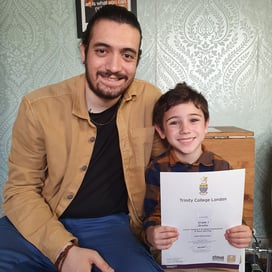
For example, I had a seven-year-old student who came to the studio to learn Rock & Pop Drums. After a year with very little progress, I realised that the approach was not the right fit for him. We switched to the Snare Drum syllabus and orchestral repertoire, and within three months he achieved his Initial Grade certificate. We are now preparing for Grade 1.
Furthermore, it is important to identify whether my learner has a musical background. This can be done simply by asking, "What kind of music do you like to listen to at home?" If they are very young and have not yet developed musical awareness, I will suggest to the parents that they begin listening to music at home. I also use some lesson time to listen to music, as it is enjoyable and engaging for them.
Motivation and Musical Identity
We should not forget that, as music educators, we are also responsible for introducing students to different styles of music and allowing them to try and experiment until they decide how they wish to develop as musicians and build their musical identity.
To conclude, every student has different abilities, but that is perfectly acceptable as long as we teach them in a way that enables them to learn their instrument properly. Some will have the passion and talent to reach Grade 8, others may achieve lower grades, and some may not become interested at all, like Aaron Spears at the beginning.
As educators, our role is to understand our students' abilities and motivate them to achieve their goals.
Would you like to learn more about the graded music exam options for drummers and percussionists highlighted in this post? Then check out our Classical & Jazz Drum Kit & Percussion and Rock & Pop Drums syllabuses.
Sign up to receive emails from Trinity College London

Related posts

BY: John Molloy
BY: Natalie Christopher
%20(1).jpg)
Comments & Replies